
The Price Of Money Has Changed
Published Aug 2026 Download this Note
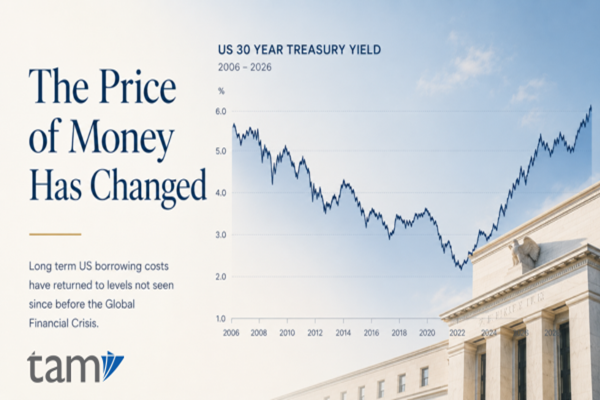
For much of the past fifteen years, markets became accustomed to a world in which money was unusually cheap.
Interest rates remained close to zero for long periods, inflation was subdued and central banks were quick to provide support whenever economic conditions weakened. Governments borrowed cheaply, companies borrowed cheaply and investors became increasingly comfortable with the idea that, eventually, interest rates would always come back down.
That world increasingly looks like the exception rather than the norm.
And this is no longer simply an American story. Long term US Treasury yields have returned to levels not seen for almost two decades. In the UK, long dated government borrowing costs have recently reached levels last seen in the late 1990s, while French government bonds have also come under pressure as markets focus increasingly on debt and fiscal sustainability.
Perhaps most strikingly, in Japan, a country synonymous with near zero interest rates for a generation, long term government bond yields have risen to levels that would have seemed almost unthinkable only a few years ago.
These are very different economies facing very different challenges, but their bond markets are delivering an increasingly similar message.
THE PRICE OF MONEY HAS CHANGED.
The era of exceptionally cheap capital may be behind us, with implications reaching far beyond the bond market.
It is tempting to view bond markets almost entirely through the actions of central banks. When will the Federal Reserve move rates? What will the Bank of England do next? How quickly will the Bank of Japan normalise policy?
But central banks only directly control the very short end of the interest rate curve. They do not ultimately determine the return investors demand to lend money to a government for twenty or thirty years. Increasingly, that price is being influenced by a much broader set of forces.
Inflation remains above target in many major economies. Government borrowing requirements are substantial and fiscal deficits remain large. Defence and infrastructure spending are increasing, while enormous investment programmes in AI, energy and technology are creating further demand for capital. At the same time, some central banks that spent years buying government bonds are reducing their presence in those markets.
Governments therefore need to attract private capital to finance increasingly significant borrowing requirements, and investors are understandably demanding to be paid for doing so.
Taken together, these forces challenge one of the assumptions that dominated markets for much of the period following the Global Financial Crisis: that interest rates would inevitably return to the exceptionally low levels to which markets had become accustomed.
THIS MATTERS FAR BEYOND BONDS
Government bond yields provide the starting point against which many other investments are judged. If attractive returns can once again be earned from relatively low risk assets, greater prospective returns should naturally be demanded elsewhere.
That has implications for equity valuations, property, private markets and corporate borrowing. More broadly, it raises the hurdle rate for investment and changes the cost of capital throughout the economy.
The last decade encouraged capital further along the risk spectrum in search of return. When cash yielded almost nothing and government bonds offered little more, there was a powerful incentive to own equities, property, private assets and longer duration investments. A world in which investors are once again paid meaningful returns simply for lending money changes that calculation.
WHAT DOES THIS MEAN FOR TAM PORTFOLIOS?
We have maintained an underweight position in fixed income across our multi asset strategies for some time. This has never reflected a belief that bonds no longer have an important role to play. Rather, we have questioned whether portfolios were being adequately rewarded for taking long term interest rate risk.
Recent moves are beginning to change that equation. Higher yields mean better prospective returns and, in that sense, the adjustment we are seeing in bond markets is not necessarily bad news for long term portfolios. Quite the opposite. Every move higher in yields potentially makes the asset class more interesting.
However, better value does not automatically mean good value. With inflation still above target, government borrowing remaining elevated and the longer term path for interest rates increasingly uncertain, we see little reason to rush into significant long duration exposure simply because yields have moved higher. For now, we believe patience remains appropriate.
Our underweight position has reduced portfolio sensitivity to the rise in long term yields, while allowing us to allocate capital towards areas where we believe the balance between risk and potential return remains more attractive. Importantly, our view on bonds is not static. There will come a point at which higher yields provide sufficient compensation for the risks involved, and one consequence of the recent adjustment is that we may now be considerably closer to that point.
After more than a decade in which many parts of the bond market offered very little income, investors are once again being paid meaningful returns to lend money. That is ultimately a healthy development. The more difficult question is whether today's yields represent the destination, or simply another stage in the adjustment from an era of exceptionally cheap money towards something more normal.
For the moment, we remain cautious. But as the price of money continues to reset, an asset class we have deliberately held below benchmark may ultimately become one of the more interesting opportunities available to us.
Don’t Chase Every Shot
Who’s really driving?