
The Strait and narrow
Published May 2026 Download this Note
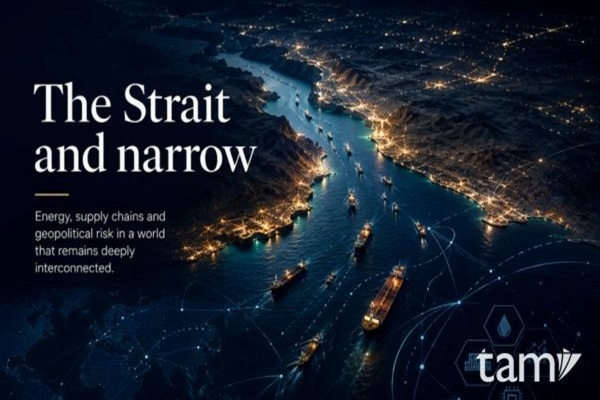
Recent disruption around the Strait of Hormuz is a reminder that energy security, supply chains and geopolitical risk still play a major role in shaping inflation, markets and portfolio positioning.
Three months ago, most people probably could not have pointed to the Strait of Hormuz on a map, let alone appreciated its importance to global markets.
Today, it has become one of the key pressure points for energy prices, inflation expectations and investor sentiment.
The Strait itself is not a new concern. It has been viewed as one of the world’s key strategic and energy chokepoints since the oil crises of the 1970s and the Tanker War of the 1980s, when disruption in the region first became recognised as a genuine global economic risk.
Roughly a fifth of the world’s oil supply passes through the Strait each day. When tensions rise in the region, markets react quickly, not just because of immediate supply concerns, but because of what sustained disruption could mean for inflation, interest rates and economic growth more broadly.
What is perhaps more interesting is that the implications now extend far beyond oil and gas alone. Modern supply chains rely on the uninterrupted movement of a wide range of commodities and industrial inputs, including metals, chemicals and materials used in technology and semiconductor production. Disruption in key shipping routes increasingly feeds through into manufacturing costs, inflation expectations and broader economic activity.
Despite the growth of renewable energy, more than 80% of global energy production still comes from fossil fuels. For all the focus on transition and decarbonisation, the global economy remains heavily dependent on stable oil and gas supply.
What is becoming increasingly clear is that not all economies are equally exposed to these risks.
The US, while certainly affected by higher oil prices, is now significantly more energy independent than it was in previous decades. Its large domestic economy and energy production capacity provide a degree of insulation from external shocks.
Europe and many Asian economies remain relatively more reliant on imported energy and global shipping routes, potentially leaving them more exposed to prolonged disruption or sustained increases in energy prices.
For investors, this matters.
What makes the current environment particularly interesting is that markets have remained remarkably resilient despite these risks. Both the S&P 500 and Nasdaq recently reached new all-time highs, supported by strong corporate earnings, continued AI enthusiasm and persistent “buy the dip” behaviour from investors.
At the same time, leadership within equity markets has become increasingly concentrated, with a relatively small number of large technology and semiconductor companies driving a significant proportion of overall market returns. While earnings momentum and AI-related investment remain powerful themes, concentration risk is also becoming increasingly difficult to ignore.
Markets may be reaching new highs, but concentration and geopolitical risk have not disappeared.
Strong markets can sometimes disguise growing concentration risk beneath the surface, particularly when leadership narrows and investor optimism becomes heavily focused on a small number of themes or companies.
The same geopolitical event can create very different economic and market outcomes depending on geography, energy dependence and inflation sensitivity.
Markets often price geopolitical events as temporary disruptions. The broader risk is when temporary disruptions begin feeding through into inflation, industrial production and longer-term economic expectations.
It also raises an interesting question for markets. Much of today’s market optimism and recent equity strength has once again become heavily centred around AI and the enormous investment being directed towards data centres, semiconductor production and digital infrastructure. Yet all of this requires vast amounts of energy. If energy prices remain elevated or supply becomes more constrained, it is reasonable to ask whether this could eventually slow parts of the AI investment cycle itself.
Technology may increasingly drive markets, but technology itself still relies heavily on physical infrastructure, energy supply and global trade networks.
Of course, these situations can change quickly. We may wake up tomorrow to news of a lasting agreement and a reopening of shipping routes. Markets could rally sharply in response. But the broader lesson remains important: modern economies remain deeply interconnected, and disruption in strategically important regions can still ripple rapidly through inflation, supply chains and investor sentiment.
Portfolio implications
From a portfolio perspective, this reinforces our preference for balanced global diversification rather than excessive concentration in any single region, sector or market narrative.
Within fixed income, we continue to favour a balanced duration profile given the uncertain outlook for inflation and interest rates, while maintaining a focus on overall credit quality. We also continue to see value in maintaining selective exposure to alternatives, commodities and other assets that may behave differently during periods of geopolitical stress or rising inflation expectations.
More broadly, it is also one reason we remain cautious about excessive concentration in a narrow group of AI-related equities, despite their strong recent performance. While the long-term opportunity remains significant, markets can sometimes underestimate the extent to which technological growth still depends on physical infrastructure, stable energy supply and functioning global trade networks.
Diversification is often viewed as a defensive concept. In reality, it is about recognising that global economies and markets do not all respond to shocks in the same way or at the same time.
Global events rarely affect all regions equally. Understanding where economies are more insulated, and where vulnerabilities remain, is becoming increasingly important in portfolio construction and asset allocation.
As ever, our focus remains on maintaining balanced, globally diversified portfolios capable of navigating a wide range of possible outcomes.
The Strait of Hormuz may not have been on many investors’ radar a few months ago. It is now a useful reminder that geography, energy security and supply chains still matter enormously.
If helpful, we would be very happy to discuss how these themes are reflected within our current portfolio positioning and asset allocation approach.
A view from Hong Kong
When markets disagree